The LB7 Duramax Injector Problem: How to Catch It, Test It, and What the Fix Really Costs
If you own an '01 to '04½ Chevy or GMC 2500/3500 with the 6.6L Duramax, there's a good chance you found this page because the oil on your dipstick smells like a fuel pump exploded in the crankcase. That smell is the LB7's signature. Of all the things that go wrong on these trucks, the injectors are the one almost every high-mileage LB7 deals with eventually — and the one most likely to get misdiagnosed as a "tune-up" before someone finally pulls the valve covers.
Here's the honest version of what's happening, how to confirm it before you spend a dime on parts, and what the job actually costs in 2026.
Why the LB7 injectors fail in the first place
The LB7 ran Bosch common-rail injectors mounted under the valve covers, down inside the heads. Great for keeping things quiet and tucked away. Terrible for the day they fail, because there's no getting to them from the top of the engine the way you can on the later LLY, LBZ, and LMM trucks.
The failure itself isn't really about wear in the normal sense. The injector bodies develop cracks, the ball seats erode, and the high-pressure seals extrude under the pressure these things live at. When that happens, fuel that's supposed to be metered into the cylinder instead bypasses internally and goes back down the return circuit — or worse, past the seals and into the crankcase. GM saw enough of these come back that they issued an extended warranty (Special Policy 04036) covering injector replacement for 7 years or 200,000 miles. That policy is long expired now, so on a 20-plus-year-old truck, the repair is on you.
That's the part owners hate to hear, but it's the truth: on an LB7, injector replacement isn't an if. It's a when.
The symptoms — and the one that actually proves it
People list a dozen symptoms for failing injectors. On an LB7, a handful matter more than the rest:
- Your oil level keeps climbing and the oil smells like diesel. This is the dead giveaway. A cracked injector or blown seal dumps raw fuel into the crankcase. If your dipstick reads higher than your last change and the oil is thin and fuel-stinky, stop driving it — fuel-diluted oil destroys bearings.
- Gray or white smoke and a "haze" at idle, especially warm. Not the black smoke of a tune or overfueling — a lighter, fuel-rich haze.
- Hard starting, long crank, rough idle that smooths out once it's good and warm.
- A knock or rattle that sounds almost like a rod, but is really one cylinder getting a bad fuel charge.
- Low power / limp mode and a drop in fuel economy you can actually feel.
A single weak injector might only show one of these. By the time you've got two or three of them, you usually have more than one injector going.
Don't replace anything until you've tested — here's how
This is where I see people waste money. They throw injectors at it, or they replace the "bad cylinder" and the truck still runs rough. On a Duramax you have two real tests, and you should run both.
1. Balance rates (cylinder contribution). Plug in a scan tool that reads Duramax data — a Tech 2 or a good aftermarket tool — get the engine fully warm (around 170°F+), idling near 680 RPM, and watch the per-cylinder balance rates. These are the corrections the ECM is making to even out each cylinder. As a rough rule: anything past ±3 mg/stroke at idle is worth a closer look, and ±5 and beyond usually means that injector is on its way out. The catch: balance rates point you at a suspect, they don't convict it. A glow plug, compression issue, or air in the system can skew them too.
2. Return (leak-off) test. This is the more honest test on these trucks. You hook a set of graduated cylinders to each injector's return, crank for about 15 seconds, and compare how much fuel each one spits back. Because the 2001–2010 Duramax injectors are pressure-differential valves, excessive return flow tells you the ball seat and bypass valve aren't sealing — which is exactly the LB7 failure mode. An injector returning way more than its neighbors is a confirmed bad one.
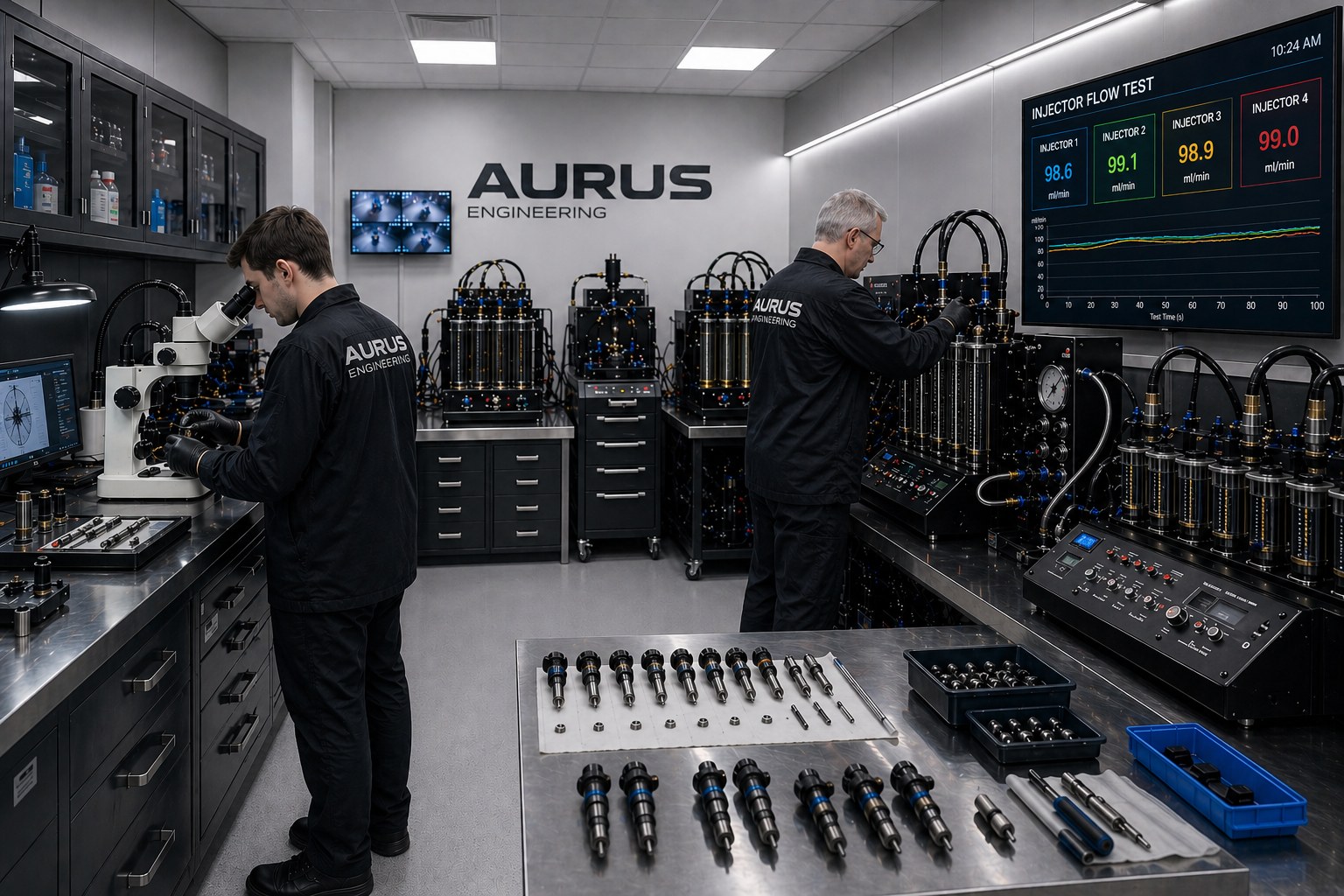
If you want the definitive answer, the only way to truly know what's happening inside is to pull the injector and put it on a calibrated flow bench. That's what a proper remanufacturing process does — every unit gets flow-tested, not eyeballed.
Should you do all eight?
Almost always, yes — and here's the reasoning, not just the upsell. The labor to get to one LB7 injector is the same brutal labor to get to all eight: valve covers off, intake off, hours of work. If you replace only the two worst on a high-mileage engine, the others are the same age and the same Bosch hardware, and they tend to start drifting within 20,000–30,000 miles. Then you're paying that monster labor bill a second time. Do the set once and be done.
What LB7 injector replacement actually costs in 2026
Two big numbers: parts and labor.
- Labor is the killer. Because the injectors live under the valve covers, you're looking at roughly 8–12 hours at a shop — call it $1,400–$2,800 depending on shop rate and whether they refresh seals, lines, and filters while they're in there (they should).
- Parts — a full set of eight quality remanufactured injectors plus the gaskets, seals, and o-rings you must replace on reassembly.
All in, a professional LB7 injector job in 2026 commonly lands somewhere between $3,000 and $6,000. DIY drops it a lot if you've got the tools, a torque spec sheet, and a free weekend — but understand this is a deep job, and getting the high-pressure connections and torque right matters.
For reference: the OEM Bosch reman injector for the LB7 is commonly cross-referenced as Bosch 0 986 435 502 (GM #97729095), with AC Delco 217-2078 showing up as a common service number. Always confirm fitment to your exact build before ordering — federal and California emissions LB7s and the early/late split can differ.
The bottom line
The LB7 is a great engine sitting on top of one known weak point. Catch the injectors early — watch that oil level — test before you buy, and replace the full set with properly flow-tested units. Do that, and these trucks will run another couple hundred thousand miles without complaint.
If you're sorting out which injectors fit your truck, start with the Duramax / Chevrolet injector listings or talk to someone about diesel injector service and remanufacturing. And if you're chasing down a check-engine light first, the diagnostic trouble code guide is a good next stop.
(Diesel readers also tend to find the 6.0 Power Stroke injector guide useful — different engine, same "test before you throw parts at it" lesson.)
Frequently Asked Questions
How do I know if my LB7 injectors are bad?
The clearest sign is engine oil that rises on the dipstick and smells like diesel — that's fuel leaking into the crankcase from a failing injector. Other tells are gray/white haze at idle, hard starting, rough idle until warm, a knock from one cylinder, and low power. Confirm with balance rates and a return (leak-off) test before replacing anything.
Can I just replace one or two bad LB7 injectors?
You can, but on a high-mileage truck it's usually a false economy. The labor to reach one injector is the same as reaching all eight, and the remaining originals are the same age and tend to fail within 20,000–30,000 miles. Most experienced Duramax techs replace the full set on high-mileage engines.
Why is LB7 injector replacement so expensive compared to other Duramax engines?
The LB7 (2001–2004.5) places its injectors under the valve covers, so the valve covers and intake have to come off to reach them — roughly 8–12 hours of labor. Later Duramax engines (LLY, LBZ, LMM) moved to top-accessible injectors, which is why those jobs are cheaper.
Is the GM LB7 injector warranty still good?
No. GM's extended coverage (Special Policy 04036) ran for 7 years or 200,000 miles from the in-service date and has long since expired on every LB7. Replacement cost today is the owner's responsibility.
What does a full LB7 injector job cost in 2026?
Most professional replacements land between roughly $3,000 and $6,000 all in — about $1,400–$2,800 in labor plus a set of eight quality remanufactured injectors and the required gaskets and seals. Doing it yourself lowers the cost significantly but it's an involved job.
What's the difference between balance rates and a return test?
Balance rates are the ECM's per-cylinder fueling corrections read on a scan tool — they point to a suspect cylinder. A return (leak-off) test measures how much fuel each injector sends back during cranking and is the more reliable confirmation of a worn ball seat or bypass valve, which is the classic LB7 failure.
Frequently Asked Questions
How do I know if my LB7 injectors are bad?
The clearest sign is engine oil that rises on the dipstick and smells like diesel — that's fuel leaking into the crankcase from a failing injector. Other tells are gray/white haze at idle, hard starting, rough idle until warm, a knock from one cylinder, and low power. Confirm with balance rates and a return (leak-off) test before replacing anything.
Can I just replace one or two bad LB7 injectors?
You can, but on a high-mileage truck it's usually a false economy. The labor to reach one injector is the same as reaching all eight, and the remaining originals are the same age and tend to fail within 20,000–30,000 miles. Most experienced Duramax techs replace the full set on high-mileage engines.
Why is LB7 injector replacement so expensive compared to other Duramax engines?
The LB7 (2001–2004.5) places its injectors under the valve covers, so the valve covers and intake have to come off to reach them — roughly 8–12 hours of labor. Later Duramax engines (LLY, LBZ, LMM) moved to top-accessible injectors, which is why those jobs are cheaper.
Is the GM LB7 injector warranty still good?
No. GM's extended coverage (Special Policy 04036) ran for 7 years or 200,000 miles from the in-service date and has long since expired on every LB7. Replacement cost today is the owner's responsibility.
What does a full LB7 injector job cost in 2026?
Most professional replacements land between roughly $3,000 and $6,000 all in — about $1,400–$2,800 in labor plus a set of eight quality remanufactured injectors and the required gaskets and seals. Doing it yourself lowers the cost significantly but it's an involved job.
What's the difference between balance rates and a return test?
Balance rates are the ECM's per-cylinder fueling corrections read on a scan tool — they point to a suspect cylinder. A return (leak-off) test measures how much fuel each injector sends back during cranking and is the more reliable confirmation of a worn ball seat or bypass valve, which is the classic LB7 failure.