Inside a Fuel Injector Remanufacturing Lab: How It Actually Works
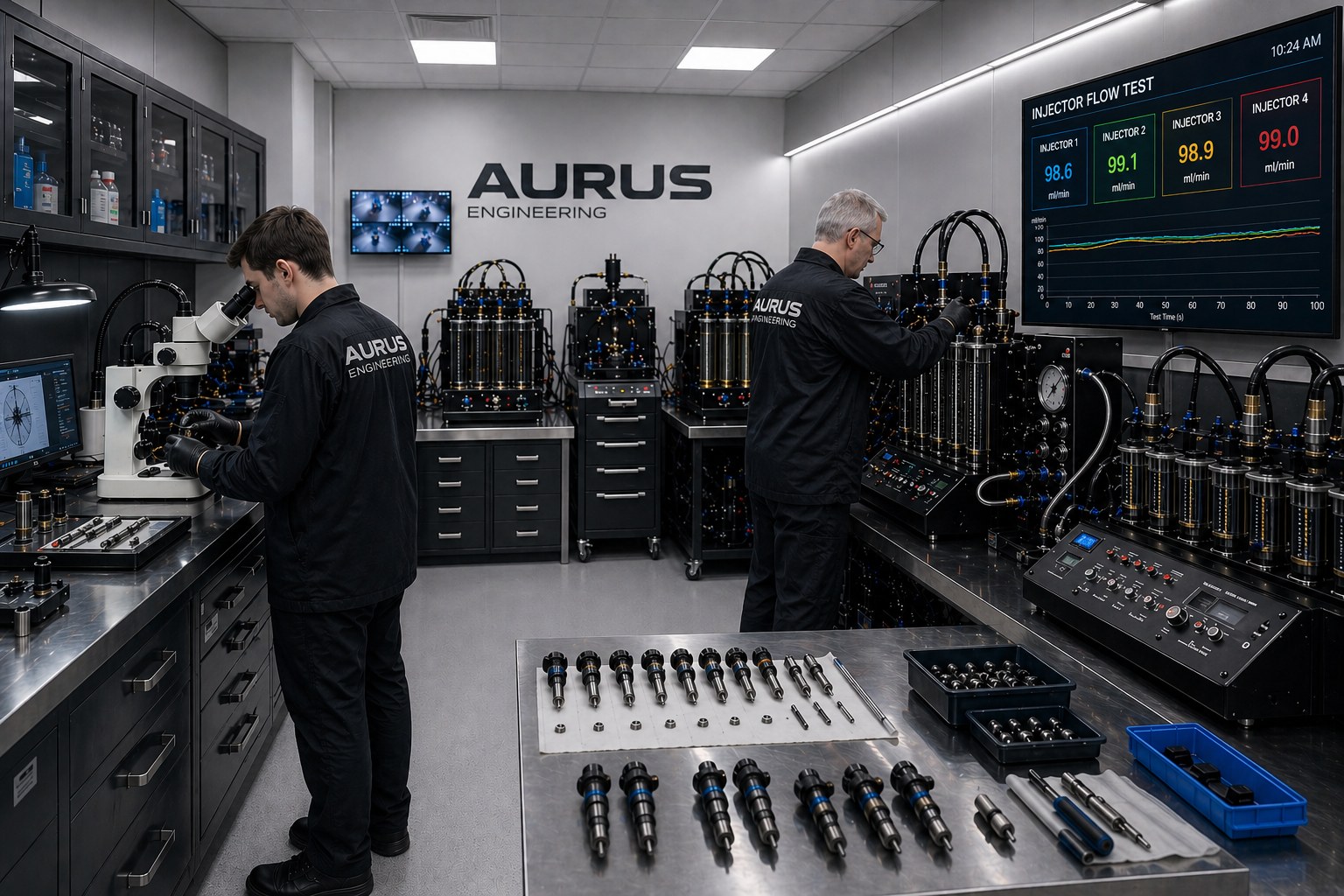
If you've ever priced a brand-new OEM fuel injector at a dealership, you already know the punchline: a single Bosch unit for a modern GDI engine can run north of $400, and a six-cylinder set will swallow a paycheck. That sticker is the reason remanufactured injectors exist. But "remanufactured" is one of the loosest words in the automotive aftermarket. On one end of the scale, it means a careful, instrumented rebuild on calibrated benches. On the other, it means somebody dunked an injector in solvent, screwed a new O-ring on, and threw it in a box.
This is what the careful end actually looks like — the version we run at our Long Beach lab — so the next time you order a remanufactured injector, you know what you're paying for and what to ask the seller before you click checkout.
The injector arrives. The first thing we do is not clean it.
When a customer mails us a set of injectors for service, the first stop isn't the ultrasonic tank. It's the inspection bench. We photograph the injectors, log the part numbers, weigh each unit, and check for visible damage — cracked bodies, sheared electrical connectors, corrosion around the upper O-ring groove, signs of someone having pried the pintle cap off with a screwdriver.
This step matters because a fuel injector tells you a story before it ever sees a flow bench. A unit that arrives with rust pitting on the body has lived in a humid garage or a flood-affected vehicle. One with carbon caked around the lower seal area is usually a victim of a heat-soaked fuel rail. A GDI injector with brown discoloration on the tip has been running rich, often because the upstream injector in the same bank was already failing.
"A fuel injector tells you a story before it ever sees a flow bench. Rust pitting means humidity. Brown discoloration means rich-running. We document all of it before any cleaning starts."
We document all of it because the diagnostic data we collect after testing is most useful when paired with what the injector looked like coming in. That's also the point at which we tell the customer, before any money changes hands, whether the unit is salvageable or whether it should be replaced outright. A surprising number of injectors that get mailed in are dead — armatures fused, coils internally shorted, or the precision spray plate cracked. No amount of rebuilding fixes those. Our job is to be honest about it. If you suspect yours are failing, our fuel injector symptoms guide is the fastest way to triage before you ship anything.
The 40kHz dual-frequency ultrasonic bath
Once an injector has cleared visual inspection, it goes into the ultrasonic tank. This is the step most "fuel injector cleaning" services stop at, but for us it's just the start.
The bath runs at 40kHz with dual-frequency modulation. The frequency matters more than most people realize. Too low, and the cavitation bubbles get aggressive enough to scratch the precision-machined surfaces inside the nozzle. Too high, and they don't have the energy to break up the varnish and lacquer that builds up on the pintle and inside the fuel gallery. Forty kilohertz, with a brief secondary sweep, is the sweet spot the OEMs themselves use during manufacturing.
The cleaning solution isn't carburetor cleaner from an auto-parts store. It's a heated alkaline solution specifically formulated to dissolve gum, varnish, and the unburnt-fuel residue that bakes onto the inner walls of an injector during shutdown heat-soak. After the alkaline cycle, parts go through a neutralizing rinse and a deionized water flush so no chemical residue remains.
"Visually clean is not the same as functionally clean. That's why we don't ship anything based on the ultrasonic step alone."
What comes out the other side is a visually clean injector — but visually clean is not the same as functionally clean, and that's why we don't ship anything based on this step alone.
Disassembly to the armature
Most aftermarket "rebuild" services treat injectors as black boxes. They run them through a flow bench, see if they pass, and if so, declare them rebuilt. We disassemble.
A port fuel injector comes apart into roughly fourteen distinct components: the upper and lower body, the armature, the spring, the spring-cup, the electrical solenoid winding, the seat, the pintle, the pintle cap, the filter basket, and several seals and O-rings. Every one of those parts has a specification — a measured tolerance written into the original engineering drawings.
We measure them. The bore where the armature travels is checked with a calibrated air gauge. The seat is inspected for pitting. The spring is tested for free length and load at compressed length. The coil resistance and inductance are checked against the OEM spec sheet for that specific part number — a Bosch EV6, for example, has a different signature than a Denso 23250 series, and using one bench setting for both is how shoddy services miss bad coils.
"Anything that falls outside OEM tolerance gets replaced, not adjusted. We do not lap a worn seat or stretch a tired spring."
Anything that falls outside OEM tolerance gets replaced, not adjusted. We do not lap a worn seat or stretch a tired spring. The cost of new parts at this scale is real, but it's the difference between an injector that performs to factory spec for another decade and one that limps for six months.
OEM parts only — no generic seal kits
The replacement parts come from the original suppliers: Bosch, Denso, Siemens VDO, Delphi, Continental, AC Delco. We don't use the universal seal kits sold in twelve-packs on online marketplaces. Those kits often look right but use Viton blends with subtly different swell rates, and a mismatched lower O-ring in a hot fuel rail is one of the most common causes of a "rebuilt" injector failing within a few thousand miles. The trade-offs between original-supplier parts and generic ones are exactly the case we walk through in OEM vs aftermarket.
This is also where GDI work splits from port-injection work. A direct-injection injector operates at fuel rail pressures up to 2,900 psi (not the 45-90 psi of a port injector), and the seals that ride against that pressure are essentially miniature engineering parts. They have to be sourced from the right supplier, in the right durometer, or the injector will leak past the upper seal under load and dump fuel into the cylinder under conditions where the engine ECU isn't expecting it.
"A mismatched lower O-ring in a hot fuel rail is one of the most common causes of a rebuilt injector failing within a few thousand miles."
Electrical and leak testing at 1.5× operating pressure
With the injector reassembled, it gets clamped into a test fixture for electrical and leak verification.
The electrical side is straightforward — we measure coil resistance, insulation resistance, and inductance, and we compare each value against the spec for that part number. A healthy port injector usually sits between 12 and 16 ohms; a peak-and-hold high-impedance unit might land anywhere from 2 to 4 ohms. The number itself isn't the point. The point is consistency across a set: if you're rebuilding a four-cylinder set and one injector reads 13.4Ω while the others read 14.6Ω, that one is going to fire slightly differently and will eventually show up as a misfire on a cold morning.
Leak testing is done at 1.5 times the injector's rated operating pressure. The injector is energized closed and pressurized, and we watch for any drip at the nozzle and any seep past the upper or lower seals. Anything more than zero is a fail. A working fuel injector should hold pressure indefinitely with the solenoid de-energized; if it doesn't, you'll see hard starts after the engine sits, rough cold-running, and elevated hydrocarbon emissions.
"Anything more than zero drip is a fail. A working fuel injector should hold pressure indefinitely with the solenoid de-energized."
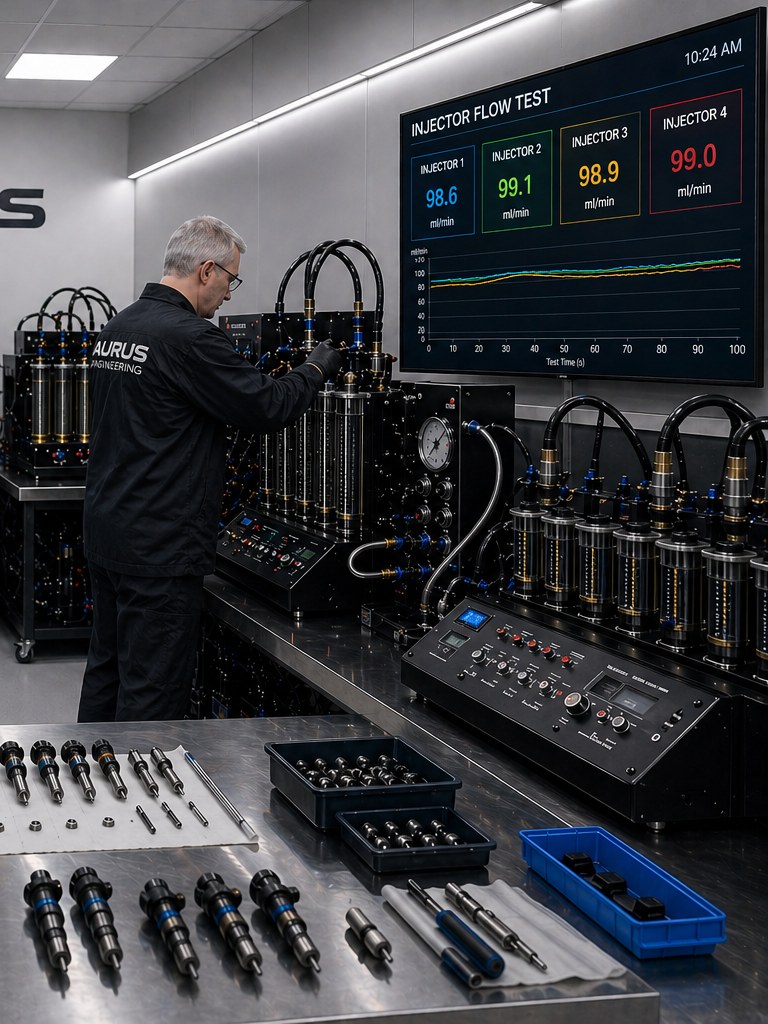
Flow and spray testing on the Bosch EPS 815
This is the bench that does the heavy lifting. The Bosch EPS 815 is the same equipment used by certified Bosch service centers worldwide, and our GDI work runs on a parallel ASNU bench specifically rated for direct-injection units.
We flow each injector at multiple pulse widths, not just one. A common shortcut is to test at a single 2.5-millisecond pulse and call it good. The problem is that injectors can flow within tolerance at that pulse width and still be wrong everywhere else. Real-world driving spends most of its time below 2.5ms, in the short-pulse region where atomization quality and minimum pulse-width consistency matter most. We test at six or more pulse widths spanning idle, cruise, and wide-open throttle conditions.
Alongside flow rate, we measure spray pattern, cone angle, and drip rate. Spray pattern is documented with a calibrated catch grid that shows the distribution of fuel across the cone. Cone angle is verified against OEM spec — a port injector that should produce a 25-degree cone but actually produces a tight 12-degree column will run rich and foul a plug. A drip rate above zero means the seat isn't sealing, and the unit goes back for re-disassembly.
"We hold ±1% flow matching across a customer's set, which is tighter than the ±2-3% that most OEM-fresh injectors leave the factory at."
The output of this stage is a numerical match across the set. We hold ±1% flow matching across a customer's set, which is tighter than the ±2-3% that most OEM-fresh injectors leave the factory at.
Engine simulation — the step almost no one else does
The last bench is the one we built ourselves and the one I'd argue makes the biggest difference for the customer.
A flow bench is a steady-state environment: clean fuel, stable temperature, constant rail pressure. Real engines don't operate that way. They have heat soak from the manifold, pulsation from the fuel pump, varying back-pressure from the intake, and ambient temperature swings from -10°F on a January morning to +120°F under-hood on a summer freeway pull.
Our engine simulator reproduces those conditions. The rebuilt injector sees variable rail pressure, temperature cycling, and dynamic load patterns matching the engine type it's destined for. Failures that hide on a static flow bench — a marginal solenoid that opens fine cold but sticks at 200°F, a seat that seals at 45 psi but seeps at 85 psi — show up here. We've caught roughly 4-6% of injectors that passed every previous test and still failed simulation. Those go back to disassembly. The customer never sees them.
"We've caught roughly 4-6% of injectors that passed every previous test and still failed engine simulation. Those go back to disassembly. The customer never sees them."
What you get back in the box
When a finished injector ships, it comes with a QR-coded test report. Scanning the code pulls up the case file for that specific unit: flow numbers at every pulse width tested, leak result, spray pattern verification, electrical readings, the technician who signed it off, and the photograph from intake. The URL is permanent. You can share it with the shop installing the injectors. You can pull it up six years from now during a warranty claim.
That transparency is, in our view, the only honest way to sell a remanufactured part. You can't see inside the housing once it's reassembled. The test report is what lets you trust the work.
"You can't see inside the housing once it's reassembled. The test report is what lets you trust the work."
If you're considering a remanufactured set for your vehicle, the questions worth asking any seller are short: What pulse widths do you flow-test at? Do you replace seals with OEM parts or generic kits? Do you provide per-injector test data? And if the answers come back vague, keep shopping.
You can start a remanufacturing order with our lab in under a minute, or browse our catalog of OEM-equivalent injectors if you'd rather buy outright. Want to know more about us first? About Aurus.